
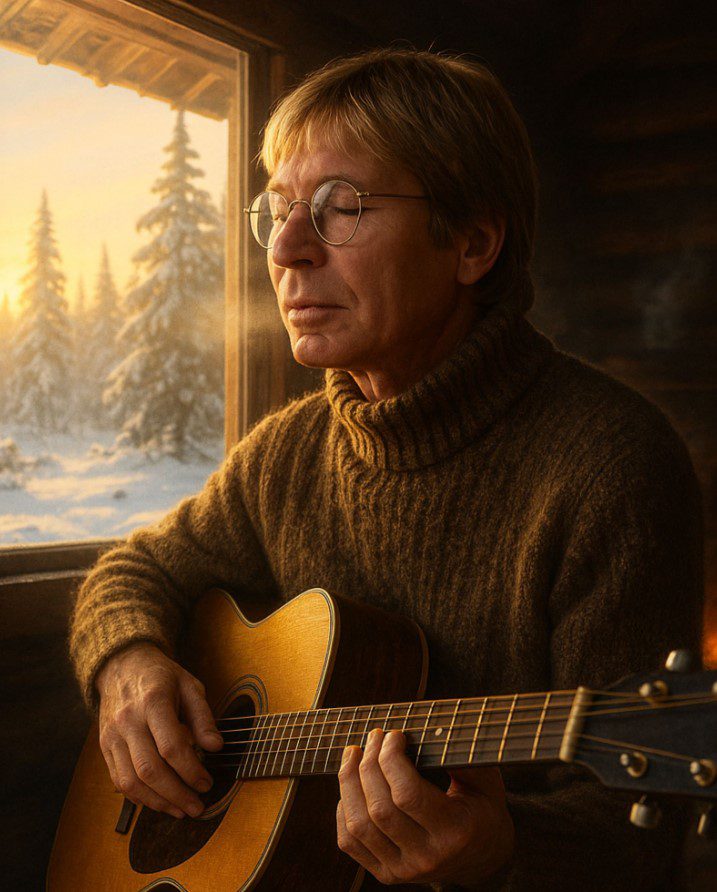
In the stillness of Colorado’s snow-covered peaks, John Denver discovered not just a melody, but a truth that would echo through generations. His music, born from solitude and reverence for the land, became more than a song—it became a spiritual conversation with nature. “The Song That Made the Mountains Listen” isn’t just a poetic phrase; it represents the very soul of Denver’s artistry and his lifelong dialogue with the mountains that shaped his heart and his sound.
A Cabin, a Silence, and the Birth of a Song
Far from the bustling streets of Nashville or Los Angeles, John Denver retreated into a small wooden cabin, tucked among the whispering pines of the Rocky Mountains. It was here, surrounded by snow and silence, that he found the space to listen—truly listen—to the rhythm of the earth. The fire crackled softly, the wind hummed through the trees, and somewhere between breath and stillness, a melody began to take form.
Denver often said that some songs are written, but others are born. This one was born in stillness. It came not from ambition, but from surrender—from a moment when he let the land speak through him. As he gazed out at the endless peaks, the world seemed to breathe with him, and for a moment, music became a reflection of life itself—pure, patient, and eternal.
John Denver’s Deep Connection to Nature
No artist of his era embodied nature’s spirit more intimately than John Denver. His voice was not just a vessel for melody; it was a bridge between humanity and the natural world. Songs like “Rocky Mountain High” and “Take Me Home, Country Roads” carried not only notes and lyrics, but also an elemental heartbeat, a reminder of how deeply intertwined our lives are with the earth beneath our feet.
When Denver sang about mountains, rivers, and open skies, he wasn’t describing scenery—he was describing home. His lyrics painted landscapes that were both real and emotional, capturing the serenity, awe, and humility one feels in the wild. In every word, there was a prayer for balance, a plea for understanding between mankind and nature.
The Song That Listened Back
“The Song That Made the Mountains Listen” wasn’t just inspired by the land—it was a dialogue with it. Denver believed that nature spoke in ways few people stopped to hear. To him, the mountains weren’t silent; they whispered wisdom in the wind, echoed stories in the canyons, and answered prayers in the quiet hum of life.
As he strummed his guitar and sang to the night, the mountains seemed to sing back. Every note lingered in the cold air, carried by the same breeze that shaped the trees and carved the valleys. It was as if creation itself was harmonizing with him. The experience transformed his understanding of music—it was no longer about performance or fame, but about communion and belonging.
A Moment That Changed His Life
That night in the cabin marked a turning point in Denver’s journey as both a man and an artist. He began to see music not as a product of effort, but as a gift of awareness. His later interviews often reflected on this moment as the one that taught him to listen before he sang—to let silence speak first.
What emerged was a song that carried the stillness of snow, the depth of the forest, and the eternal patience of the mountains. When it reached listeners, it moved them not through complexity but through truth. It felt familiar, ancient, as though the earth itself had been waiting for someone to give its voice a melody.
The Legacy of a Song Born in Stillness
Even decades later, the story of that mountain-born song continues to resonate. It reminds us that inspiration doesn’t come from chasing noise, but from embracing quiet. John Denver’s legacy isn’t just his discography—it’s the philosophy behind it. He taught us that to create something timeless, we must first be willing to be still long enough to hear what eternity is saying.
The mountains of Colorado still stand as silent witnesses to that night. Locals tell stories of hearing faint echoes of Denver’s melodies drifting through the valleys at dawn. Whether it’s memory or myth doesn’t matter; what matters is that the connection remains. The mountains listened once—and perhaps, they always will.
How the Mountains Shaped His Voice and Spirit
Denver’s music carried the texture of Colorado’s wilderness—clean, open, and vast. His voice, warm and unpretentious, felt like sunlight breaking through pine branches. Every chord was grounded, every lyric sincere. He sang not to impress but to express, to give gratitude for a world that had given him everything.
The isolation of his mountain retreat gave him clarity. Away from applause and expectations, he discovered the freedom of authenticity. It was there he realized that fame was fleeting, but harmony with nature was eternal. His peace came not from success, but from a quiet understanding that he was a part of something greater.
An Invitation to Listen
Today, as the noise of modern life grows louder, Denver’s story feels more urgent than ever. His music invites us to slow down, to step outside, and to truly listen—to the wind, to the water, to the unspoken heartbeat of the world. If we do, we might find what he found: peace, purpose, and the kind of joy that doesn’t need applause.
“The Song That Made the Mountains Listen” isn’t just a tale of creativity—it’s a reminder that the greatest songs don’t come from striving, but from surrendering. When we listen deeply enough, we discover that the world has always been singing. John Denver simply had the grace to sing along.
In every note, every pause, and every breath of his music, John Denver gave us a lesson: that to truly create, one must first listen—to the mountains, to the silence, and to the song that lives within us all.